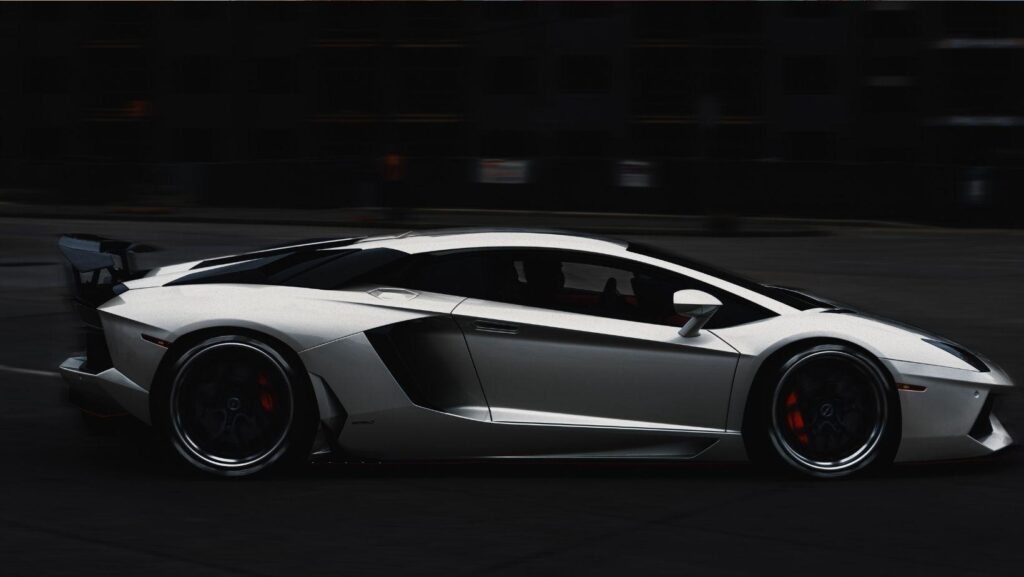
Even supercars are going electric. This process is rapid. For those appreciating raw driving, Lamborghini Aventador rental might be the perfect choice. In this article, we will look into the models features and consider 5 reasons making it the top pick for purists.
Brief Overview
Lamborghini’s Revuelto makes 1,001 hp. It’s faster, more refined, and more technologically advanced than anything the Aventador ever was. It also has three electric motors, a plug-in hybrid system, and an 8-speed dual-clutch gearbox.
Many see this as a trade-off. Aventador represents the opposite end of that trade.
“Purity” in practice:
- No turbochargers, no hybrid assist, no electric torque fill;
- A soundtrack isn’t partially synthetic or acoustically managed;
- Mechanical feedback arrives unfiltered, harshness included;
- Driver inputs that produce direct consequences.
The Aventador is the last of a specific philosophy, which Lamborghini has formally abandoned.
Reason #1: The V12 Will Never Happen Again
The Aventador’s L539 engine is a 6.5-liter, naturally aspirated V12 with a 8,700 rpm redline and 769 hp in Ultimae trim. Zero turbos. Zero hybrid motors. Zero compromises to emissions regulations.
The Revuelto uses the same block, revised to 825 hp, but pairs it with three electric motors for a combined 1,001 hp. The V12 is still in there, but it’s no longer alone. The PHEV configuration allows for electric-only driving over short distances. That’s a different kind of car.
Non-hybrid NA V12 road cars in 2025:
|
Manufacturer |
V12 Status |
|
Lamborghini |
Hybridized (Revuelto PHEV) |
|
Ferrari |
Ferrari 12Cilindri, NA V12, non-hybrid |
|
McLaren |
No V12 in lineup |
|
Aston Martin |
Valkyrie V12 is hybrid-assisted |
Ferrari’s 12Cilindri is the only other non-hybrid NA V12 road car. The Aventador didn’t exit the market but left a category that barely exists right now.
Reason #2: The Gearbox
The Aventador uses a 7-speed single-clutch ISR gearbox. It’s been criticized since 2011 for being jerky, abrupt, and unrefined in slow-speed traffic.
Every word of that criticism is accurate. And it’s also precisely why purists are reconsidering it.
ISR vs. Revuelto’s DCT, the difference:
- The ISR transmits mechanical sensation. Every shift is a physical event you feel in your spine;;
- The Revuelto’s 8-speed DCT executes shifts in milliseconds, with virtually no driver-perceptible jolt
- One feels like a machine working; the other feels like software executing a command.
Road & Track noted that the ISR’s harshness contributes to the “raw, unfiltered character” reflective of Aventador’s driving personality.
A DCT is objectively faster. But the Aventador isn’t competing in that race anymore. It’s competing for a different kind of experience: one where the driver earns the performance rather than requesting it.
Reason #3: The Investment Case Is Already Playing Out
Lamborghini built approximately 11,465 Aventadors in total across all variants. Production ended in 2022. The final unit, VIN #11,465, was sold at RM Sotheby’s Monterey 2022 for 1,007,000.
Historical precedent:
- The Murciélago, as the last Lamborghini V12 to offer a manual transmission, has appreciated significantly in the collector market post-production;
- The Diablo followed a similar trajectory, initially depreciated, then recovered sharply as its “last of kind” status crystallized;
- Depreciation stalls, then reverses, once the successor becomes mainstream and the predecessor’s uniqueness becomes solid.
2026 as a specific inflection point:
The Revuelto is now in full production. Aventadors are increasingly appearing at specialist auctions rather than dealer forecourts. And the “final non-hybrid NA V12 Lamborghini” narrative, which was abstract in 2022, is now a documented historical fact. The collector markets price certainty, and that certainty now exists. Limited color specifications and documented single-owner histories compound the value case.
Reason #4: The Design Hasn’t Aged
The Aventador’s design makes it look like a jet fighter. Modern supercars, particularly hybrids, trend toward aerodynamically optimized surfacing. They are also visually quieter.
The Aventador offers:
- Confrontational visual identity from any angle;
- Scissor doors that create genuine theatre at a standstill;
- A design lineage traceable directly to the Countach (1974) and Murciélago, both now considered icons;
- Visual weight and presence that reads as “event”.
For the generation that had Aventador posters on their walls in 2012, that emotional connection compounds. The car they aspired to as teenagers is now a collectible that’s genuinely attainable, and increasingly, genuinely appreciating.
Reason #5: The Analogue Experience Is the Product
Strip away the investment case, the specs, and the history. The Aventador sells a type of experience that modern engineering is systematically eliminating.
“Analogue” in practical driving terms:
- Power delivery: The L539 V12 builds power in a linear, combustion-only curve. No electric torque fills in the gaps at low revs. You feel the engine working through every rpm band.
- Sound: Unmanaged, un-synthesized. No active noise cancellation, no sound actuators pumping engine noise into the cabin. You hear what the engine produces.
- Steering: Earlier Aventador variants use less electronically assisted steering, giving more direct road feel than heavily boosted modern systems.
- Driver aids: Present, but less intrusive. The car doesn’t constantly intervene to make you feel competent.
The Revuelto is faster everywhere but that is not the point.
The Aventador captures a specific era of supercar engineering before electrification mandates and the pursuit of sub-2-second 0-60 times. That era is over.
Final Thought
The Aventador is already history. The question is recognition: now, when prices still reflect a used supercar, or later, when they reflect an icon.
For purists, the calculus is simple: 769 hp, 8,700 rpm, no hybrid assist, no turbo, no apologies. That combination will never come from Sant’Agata again.